

Topic:ContractsAll posts on Contracts →
Commercial lease management: 53 contracts to software
How managing 53 commercial leases exposed the limits of spreadsheets, memory, and manual contract renewals, and led to AskRoby and RobyContracts.
Written by José Julio Córdova Jaramillo
Published Updated 1,137 words6 min read
53 tenants. 30 changing rent schedules. Contracts running past 40 pages. And a spreadsheet that could become outdated the moment something changed.
For 14 years, I was General Manager of La Tejedora Distrito Creativo, a commercial district in Cumbayá with more than 50 businesses operating inside two former textile warehouses.
Managing the property meant dealing with tenants, pricing, construction, operations, collections, renewals and dozens of decisions every week.
But one recurring problem kept consuming more time than it should have: the contracts.
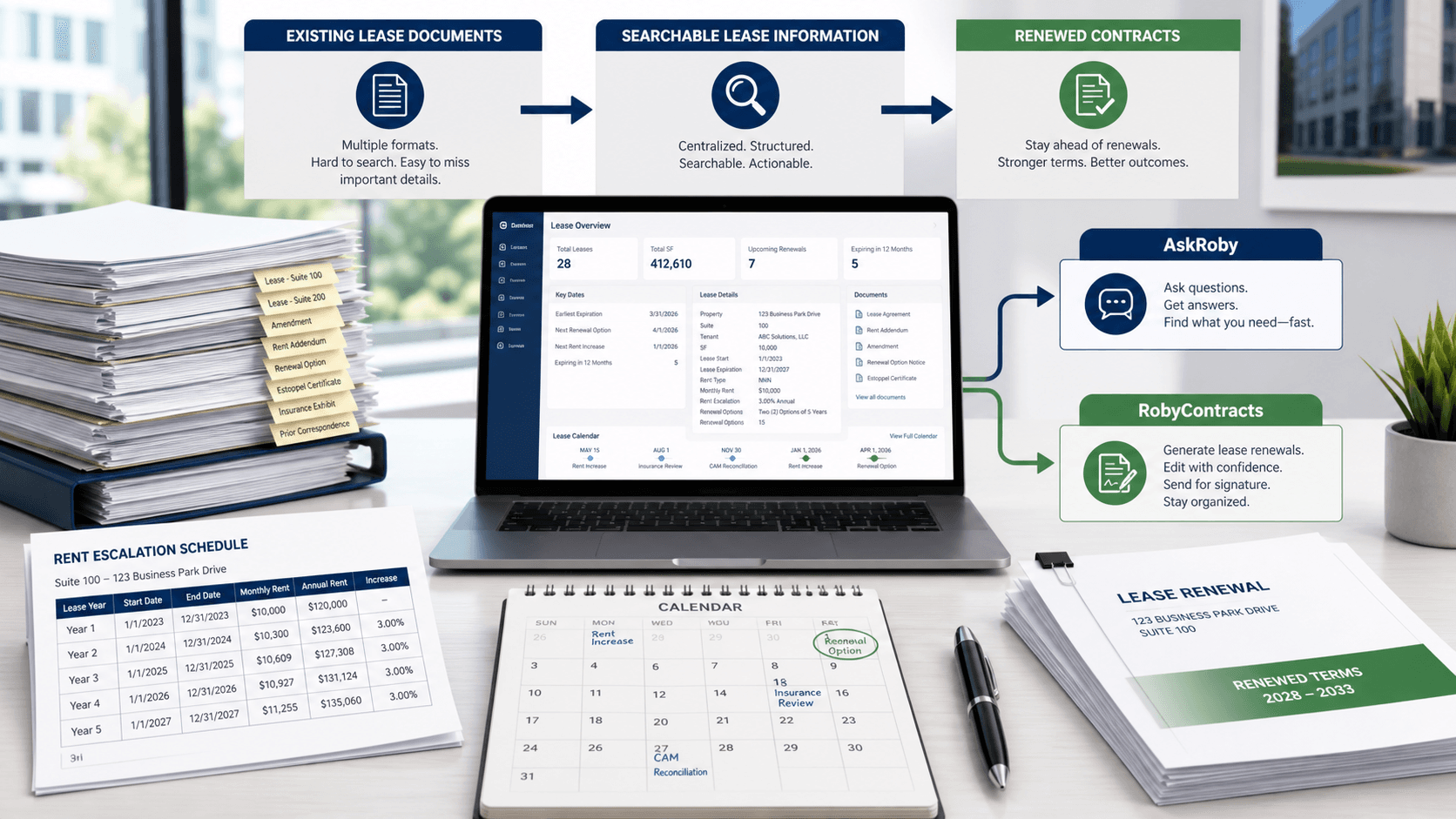
What managing 53 commercial leases actually meant #
At one point, we had 53 active commercial lease agreements. Thirty of them included rent escalation tables. The rent could change every two or three months according to a schedule written directly into the contract.
So a question as simple as, "What does this tenant pay in March?" could mean finding the contract, opening it, locating the right table and checking the corresponding period. Every time.
A spreadsheet helped, but only until something changed. Then the spreadsheet and the contract could tell two different stories.
- Annual inflation adjustments meant going back to the documents again.
- Some contracts ran past 40 pages, so nobody could reasonably remember every clause, obligation or increase.
- Renewals depended on keeping track of dates across dozens of agreements.
- Preparing the next contract meant finding the previous agreement, reviewing it, copying information, updating dates and rent values, and preparing the new document.
Why spreadsheets fail in lease management #
Spreadsheets are useful until they become a second version of the truth. In commercial lease management, the contract is still the legal source, but the spreadsheet is often where the team looks first.
That creates risk. If the rent changes, the renewal date moves, or an annual adjustment is missed, the spreadsheet can look organized while quietly disagreeing with the signed document.
That is why lease administration has to treat dates, obligations, rent schedules and clauses as operational information, not just stored files. The Business Development Bank of Canada has a plain-language guide to commercial lease terms, and Investopedia explains how the Consumer Price Index can be used in escalation contracts.
The real cost was not two hours #
Preparing a contract regularly took between 60 and 120 minutes. That sounds like an administrative inconvenience, but it was not the real problem.
The person spending those two hours was also the person who should have been thinking about occupancy, pricing, tenants, cash flow, negotiations and the operation of the business.
Instead, that time was being spent finding information that already existed and copying it from one place to another.
There was another cost that was less visible: answers given from memory. A tenant asks whether a rent increase applies this quarter. Someone remembers the contract, answers confidently, and sometimes is wrong. Then a simple information problem becomes a conversation with a tenant.
The problem was not that we had too many contracts. The problem was that critical business information was trapped inside contracts, spreadsheets, folders and people's memories.
That problem became AskRoby #
The first question I wanted to solve was simple: what if I could treat the lease portfolio as information instead of having to reopen individual documents every time I needed an answer?
That thinking eventually became AskRoby. AskRoby is designed to organize and monitor commercial lease information: expirations, rent changes, obligations, important dates and the information contained inside the agreements.
Just as importantly, when an answer comes from a contract, the source should be available to verify it. With business documents, an answer is much more useful when you can see where it came from.
Instead of depending on memory or manually searching through contracts, the objective became to make the existing lease portfolio easier to understand, search and monitor.
See AskRoby →Then came the next bottleneck #
Understanding the existing contract does not eliminate the work required when that contract needs to be renewed. We still had to create the next agreement.
That was frustrating for a simple reason: much of the information needed for the new contract already existed in the old one. The parties were there. The property information was there. The structure was there. Many of the commercial terms were there.
Yet someone still had to find that information, copy it, update what had changed, calculate new dates or values where necessary, and rebuild the agreement.
If we already understand the existing contract, why should creating the next one require starting over?
How RobyContracts helps with contract renewals #
That problem led to RobyContracts. The idea is to use the previous agreement and the organization's existing contract structure as inputs for preparing the next contract.
RobyContracts reduces repetitive administrative work and organizes the information that needs to be updated or completed.
Conceptually, the two products solve different parts of the same workflow: AskRoby helps understand, organize and monitor the lease you already have. RobyContracts helps turn that information into the next agreement.
See RobyContracts →What changed in my own operation #
After building the systems around this workflow, preparing a new contract in my own operation went from roughly 60 to 120 minutes to about 30 seconds.
Rent increases and expirations became visible without repeatedly opening contracts. Questions could be answered from the document itself rather than relying on memory. And the information already contained in an existing agreement could become the starting point for preparing what came next.
Those numbers are from my own operation with 53 tenants. Your numbers will be different. The shape of the problem often is not.
What commercial lease management software should solve #
AskRoby and RobyContracts came from a commercial lease problem, but the lesson goes beyond commercial leases. Businesses are full of processes where information already exists but is difficult to use.
People search for it, copy it, re-enter it, maintain another spreadsheet for it, try to remember it, check it again, and eventually spend an hour doing work the business has already done before.
That is why, at RobyBusinessSystems, I do not start with the question, "Where can we add AI?" I start with different questions.
- What is slow?
- What is repetitive?
- What depends on memory?
- Where is information fragmented?
- What are people constantly searching for or copying?
- What should be easier to monitor?
The bigger lesson #
Only after those questions are clear does it make sense to decide whether the answer is artificial intelligence, automation, conventional software, integrations or a combination of them.
Understand the business problem first. Then build the right system to solve it.
AskRoby and RobyContracts exist because, for years, I had exactly that kind of problem in front of me. It just took living with it long enough to realize that the contracts were not really the problem. The system around them was.
Talk about your contract workflow →