

Topic:Document intelligenceAll posts on Document intelligence →
How I Built AskRoby to Turn Contract Searching Into Verifiable Answers in Seconds
The challenge wasn't just finding answers faster. It was making sure every important answer could be checked against the contract it came from.
Written by José Julio Córdova Jaramillo
Published Updated 1,329 words7 min read
The first versions of AskRoby could answer questions about a contract.
The answers were clear.
They sounded confident.
And I didn't trust them.
That became one of the most important decisions behind the product.
Because after 14 years managing a commercial district with 53 tenants, I knew that getting an answer quickly was only half the problem.
When the answer involves rent, an expiration date, an obligation or a renewal, you need to know something else:
Where did that answer come from?
The problem was never storing the contracts #
We had the contracts.
Some were digital. Some were scanned. Some existed in physical files. We had folders, spreadsheets and years of accumulated information.
Storage wasn't the problem.
Retrieval was.
A tenant could ask a simple question:
“What does my rent change to in March?”
And answering it might mean:
Find the right contract.
Open it.
Locate the rent table.
Find the correct period.
Check whether another clause affects it.
Then answer.
With one contract, that's manageable.
With 53 tenants, contracts running past 40 pages and rent schedules that could change every two or three months, the same process repeated constantly.
A piece of information that technically already existed could still take several minutes to retrieve.
Sometimes much longer.
That was the problem I wanted AskRoby to solve.
The first transformation was simple: stop searching and start asking #
The initial idea was straightforward:
What if instead of finding the contract and then searching through it, I could simply ask the question?
“What does this tenant pay next month?”
“When does this lease expire?”
“What does the contract say about this obligation?”
“Is there a notice period?”
The system would read the agreement and return the relevant answer.
Something that might have required opening and searching through a document could now happen in seconds.
That was useful.
But it wasn't enough.
Reading a real business document is harder than it sounds #
“Read the contract” sounds like one task.
In practice, it is several different problems.
First, you have to get usable information out of the file.
A clean digital PDF is relatively easy.
A scanned signed agreement is harder.
A photograph of a page taken at an angle, with shadows or poor lighting, is harder again.
And real businesses don't operate only with perfect PDFs.
They have old contracts.
Scans.
Photographs.
Annexes.
Signatures.
Tables.
Different formats accumulated over years.
The system has to deal with the documents the business actually has, not just the documents that make a good demo.
Then there is structure.
A 40-page lease is not simply 40 pages of equal information.
Certain pieces matter operationally:
And finally, there is the question itself.
Contracts were written to define legal and commercial relationships.
They were not written to conveniently answer:
“What should I be paying attention to next month?”
Turning the document into usable business information requires more than simply extracting text.
- parties
- rent
- rent changes
- expiration dates
- renewal conditions
- notice periods
- obligations
- annexes
- other important dates and terms
Then I ran into the trust problem #
Eventually, AskRoby could produce good answers.
But I kept coming back to one concern.
For years, I had seen what happens when someone answers a contract question from memory.
They remember the clause.
They sound certain.
They give the answer.
And sometimes they are wrong.
Replacing that person with AI does not automatically solve the problem.
A confident wrong answer delivered in two seconds is still a wrong answer.
Possibly a more dangerous one.
So I made a decision that shaped the product:
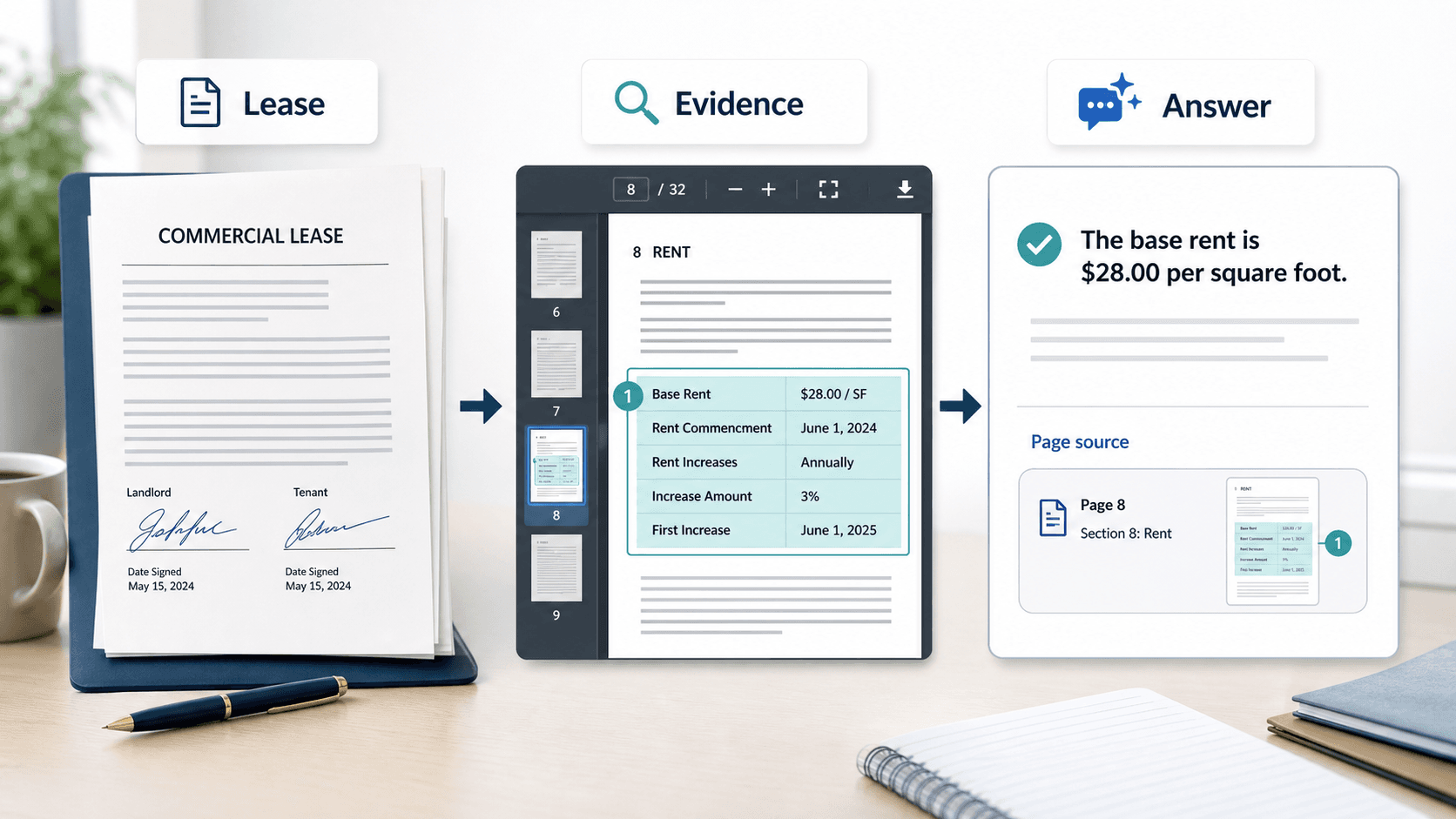
AskRoby shouldn't just provide the answer. It should show the evidence.
If AskRoby tells you when a lease expires, you should be able to see the page supporting that answer.
If it tells you what the rent changes to, you should be able to check the relevant section or table.
If it identifies an obligation, you should be able to go back to the contract and verify it.
The contract remains the source of truth.
AskRoby helps you get to the information faster.
That changed the product #
There is a big difference between:
“The AI says the lease expires on this date.”
and:
“The lease expires on this date, and here is the page in the signed agreement where that information comes from.”
The first asks you to trust the system.
The second gives you something you can check.
That distinction became fundamental to how I think about AskRoby.
An answer you cannot verify is asking for trust it has not earned.
The source page isn't a decorative feature.
It is part of the product's trust model.
Especially when the answer can affect rent, renewals, obligations or conversations with tenants.
See AskRoby →But AskRoby became more than faster contract search #
Once information inside the contracts became easier to retrieve, another opportunity became obvious.
Some information matters not because someone is asking about it today, but because something is going to happen in the future.
A lease will expire.
A rent value will change.
A notice period will begin.
A renewal will need to be prepared.
So the problem wasn't only:
“Can I find the answer?”
It also became:
“Can the system help me see what is coming before I need to go looking for it?”
That is why I don't think of AskRoby as simply “chat with a PDF.”
The objective is broader:
turn a portfolio of commercial leases into organized, usable and monitorable business information.
Searching is part of that.
Evidence is part of that.
Dates and changes are part of that.
The real value is having better control of information that was previously trapped inside individual documents.
And then AskRoby exposed the next problem #
Once the existing contract became easier to understand, another repetitive process stood out.
Renewals.
When it was time to prepare the next agreement, much of the information required already existed in the previous contract.
The parties were there.
The property information was there.
The structure was there.
Many of the terms were there.
Yet someone still had to find the old agreement, copy the information, update what had changed and prepare a new document.
That became the problem behind RobyContracts.
The relationship between the two products is straightforward:
AskRoby helps organize, understand and monitor the agreement you already have.
RobyContracts helps use that existing information to prepare the agreement that comes next.
They solve different parts of the same commercial lease workflow.
See RobyContracts →What building AskRoby taught me #
The biggest lesson wasn't about AI.
It was about designing around the actual business problem.
If I had started with:
“I want to build an AI application for documents.”
I could have built many things.
But that wasn't the starting point.
The starting point was much less glamorous:
I was spending too much time looking for information that I already had.
From there, the questions became clearer.
How do we make that information easier to retrieve?
How do we make the answers verifiable?
How do we handle the imperfect documents businesses actually use?
How do we make important future events visible?
How do we reduce the amount of work that depends on somebody remembering what is inside every agreement?
That way of thinking eventually became central to how I approach RobyBusinessSystems.
I don't begin with:
“Where can we add AI?”
I begin with:
What is slow?
What is repetitive?
Where is information difficult to retrieve?
What depends too much on memory?
What should the business be able to see or control more easily?
Then we decide whether the right answer is AI, automation, conventional software, integrations or some combination of them.
Because the objective isn't the technology.
The objective is the better business system.
AskRoby started with 53 commercial leases and a simple frustration:
The answer was already somewhere inside the contract.
Getting to it — and knowing I could trust it — shouldn't have been so difficult.